He Accidentally Created the Internet's Favorite Ghost Photo — Then Spent Three Decades Trying to Kill It
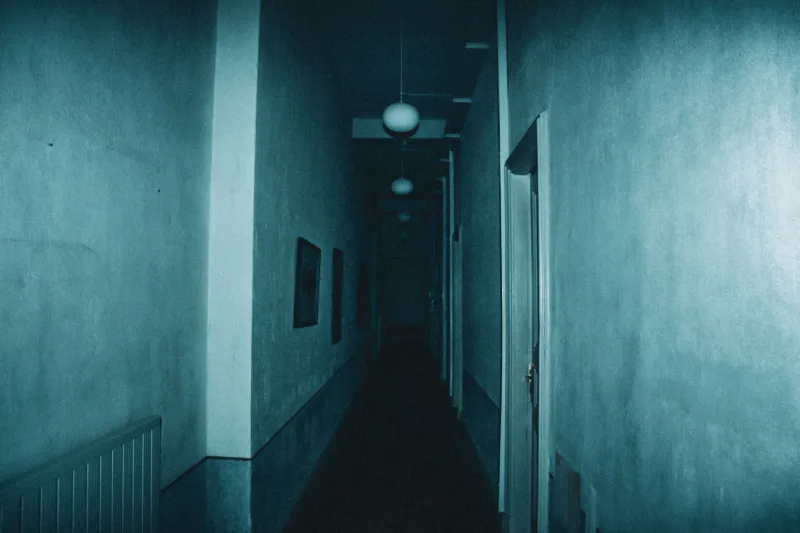
If you've spent any time in paranormal corners of the internet — and no judgment if you have — there's a decent chance you've seen the photo. A long stone hallway. Afternoon light cutting through a narrow window. And there, at the far end, a translucent human figure, slightly blurred, slightly wrong, standing in a doorway that leads nowhere obvious.
For years it circulated under variations of the same caption: Taken at [English manor], 1986. Photographer unknown. No explanation ever found.
The photographer was not unknown. He was a travel writer and commercial photographer from Ohio named Gerald Mast. And he had a very thorough explanation. He just couldn't get anyone to listen to it.
The Experiment Nobody Remembered
In the summer of 1986, Mast was on assignment in England, shooting atmospheric interiors for a regional travel publication. The manor in question — a genuine 17th-century property with a genuine reputation for being haunted, because England has those in abundance — was on his list for a two-day shoot.
Mast was not a believer in the paranormal. He was, by his own description in journal entries later made available to journalists, "interested in light and deeply skeptical of everything else." But he was curious about a photographic technique he'd been reading about: intentional double exposure, where two separate images are captured on the same frame of film to create a layered, translucent effect.
He ran the experiment several times that weekend, using a long hallway in the manor as his canvas. For one frame, he photographed the empty corridor. Then he rewound the film slightly and shot the same frame again with a colleague — a fellow photographer named Dennis — standing at the far end in a light-colored jacket. The result, if it worked, would show Dennis as a semi-transparent presence overlaid on the empty hallway.
It worked. A little too well.
Mast noted the experiment in his journal, labeled the negative, and moved on. The image was never submitted to the travel publication — it wasn't what they'd hired him for. It went into a box with dozens of other experimental frames.
Enter the Internet
Somewhere around 2001, Mast's son was cleaning out a storage unit and found a box of old prints and contact sheets. He scanned a handful of them, including the hallway image, and uploaded them to an early paranormal discussion forum without much thought. He didn't know the story behind the photo. The label on the negative hadn't made it into the scan.
The forum lost its mind.
Within weeks, the image had spread to other paranormal sites. By 2005, it had been featured in at least two self-published books on British ghost photography. By 2010, it had its own dedicated discussion thread on a major paranormal research forum, with members debating the identity of the figure, the nature of the light source, and whether the architectural details of the hallway could help narrow down which specific haunted manor it had been taken in.
Mast, now in his late fifties and largely retired from commercial photography, discovered the photo's second life by accident when a friend emailed him a link. He recognized it immediately.
The Debunking That Nobody Wanted
What followed was, by Mast's own account, one of the most frustrating experiences of his professional life — and he'd once spent three weeks photographing a corporate retreat in Phoenix in August, so the bar was not low.
He contacted the forums directly. He posted his journal entries, dated and signed. He located Dennis — still alive, still a photographer, now living in Vermont — who confirmed the experiment in writing. Mast produced the original negative, which showed the double-exposure technique clearly when examined under proper lighting. He wrote a detailed account of the shoot, including the specific camera settings he'd used, and submitted it to two of the paranormal publications that had featured the image.
One never responded. The other published a rebuttal to his rebuttal, suggesting that his journal entries might themselves be fabricated to cover up a genuine paranormal encounter he'd witnessed and was now too frightened to acknowledge publicly.
That response was, Mast later told a journalist, "the moment I understood that I was not dealing with people who wanted to be corrected."
The Truth Has a Long Tail
The problem wasn't just true believers. It was the architecture of how information moves online. Every time Mast successfully got a debunking note attached to one version of the image, three more copies had already spread without it. The photograph existed in hundreds of places simultaneously, and most of those places had no mechanism for correction, no editorial oversight, and no particular interest in accuracy.
By the mid-2010s, the photo had appeared in a TV documentary about British paranormal locations. The documentary briefly mentioned that the image's origins were "disputed" — which, in paranormal documentary language, means roughly the same thing as "some people think it's fake, but look at it."
Mast gave his last major interview on the subject in 2019, at age 73. He was calm about it by then, if not exactly at peace. He'd spent thirty-odd years watching a technical exercise become mythology, and he'd come to understand something about the way people relate to mystery.
"The photo isn't popular because it's convincing," he told the interviewer. "It's popular because people want it to be real. And I can't compete with that. Nobody can."
Dennis, for what it's worth, finds the whole thing hilarious. He keeps a framed print of the image in his studio. Underneath it, in small type, a label reads: That's me. I was wearing a cream linen jacket. It was very hot that day.
Nobody who visits ever believes him.