The Lake That Killed Without Fire, Earthquake, or Warning — and Left Scientists Completely Speechless
There's a specific kind of horror in something you can't see, smell strongly enough to notice, or hear coming. Carbon dioxide is colorless. At low concentrations, it's harmless. At high concentrations, it displaces oxygen so efficiently that a person can lose consciousness within seconds and be dead within minutes — without ever understanding what's happening to them.
On the night of August 21, 1986, a lake in the highlands of Cameroon essentially weaponized that fact. And when scientists arrived to figure out what had happened, they realized they were looking at something that, as far as the geological record showed, had never been formally documented in human history.
A Normal Night That Wasn't
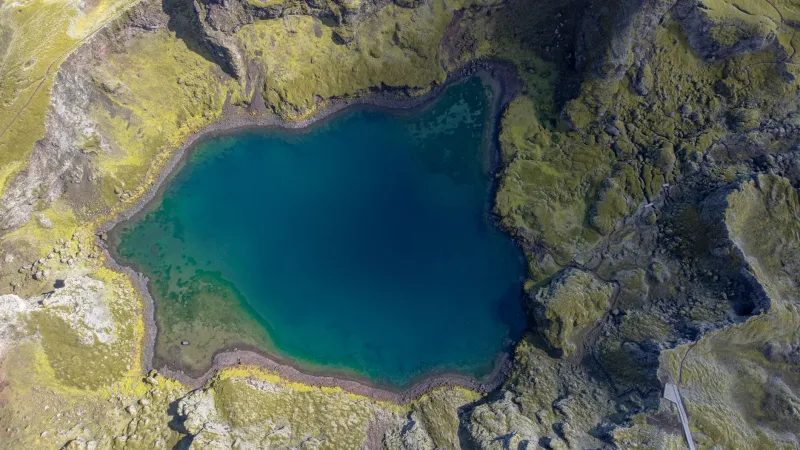
Lake Nyos sits in the crater of a dormant volcano in northwestern Cameroon. It's a striking place — deep blue water, steep green walls, the kind of landscape that looks untouched. Villages and farms dotted the surrounding area. On the evening of August 21, residents went to bed as normal.
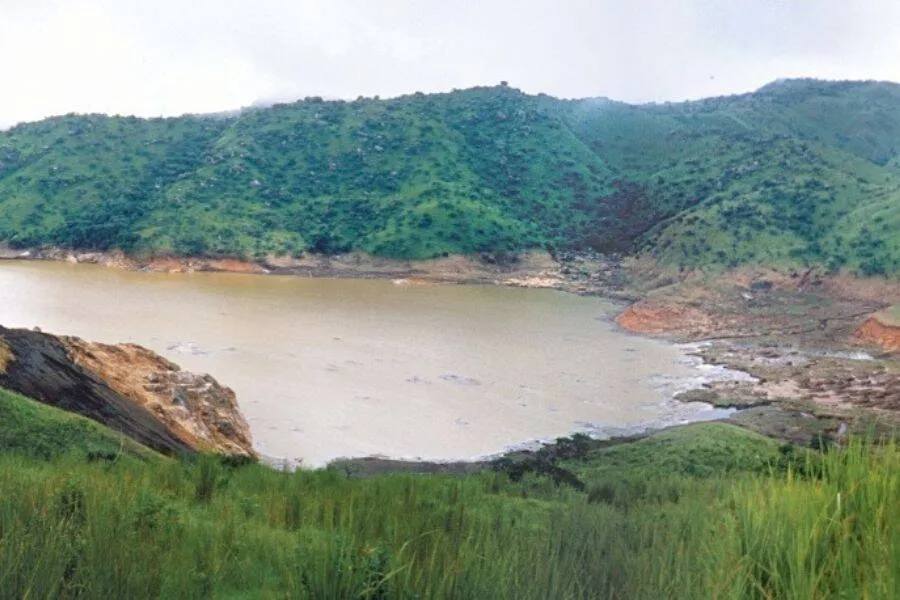 Photo: Lake Nyos, via allthatsinteresting.com
Sometime around 9 or 10 p.m., the lake burped.
That's the most accurate word for it, even if it sounds absurd. A pocket of carbon dioxide that had been building under enormous pressure at the lake's bottom suddenly destabilized and released — not in an explosion with fire or debris, but as a massive, dense, invisible cloud of gas that rolled down the surrounding hillsides at an estimated 45 miles per hour.
The cloud hugged the ground, because CO2 is heavier than air. It followed valleys and low-lying paths — exactly where people lived. It reached villages up to 15 miles away. People, cattle, insects — anything breathing in the cloud's path simply stopped breathing. Dogs, chickens, and cattle were found dead in their yards. People were found collapsed on roads, in their beds, in the middle of whatever they'd been doing.
An estimated 1,746 people died. Around 3,500 livestock. Some survivors reported smelling something faintly sulfuric before losing consciousness. Many reported waking up hours later with no memory of what had happened, surrounded by dead neighbors.
The Scientists Who Had to Invent a New Disaster
When word reached the international scientific community, the response was equal parts urgency and confusion. American and European geologists flew to Cameroon within days, and what they found forced an uncomfortable admission: they didn't have a name for this.
Volcanic activity? Not exactly — the volcano was dormant and there had been no eruption. Earthquake? No seismic activity detected. Toxic spill? No industrial infrastructure within range. The lake just... released a lethal amount of gas. Silently. Overnight.
The phenomenon they were looking at is now called a limnic eruption — a sudden degassing of a lake that has accumulated dissolved CO2 under high pressure, typically because it sits above volcanic geology. Under the right conditions, a disturbance — a landslide, a small tremor, even a strong wind — can trigger a chain reaction that releases the accumulated gas all at once.
The problem was that in 1986, limnic eruptions were essentially theoretical. There had been a smaller, similar event at Lake Monoun in Cameroon just two years earlier that killed 37 people, but it had been largely attributed at the time to a small volcanic event. Lake Nyos made the mechanism impossible to ignore.
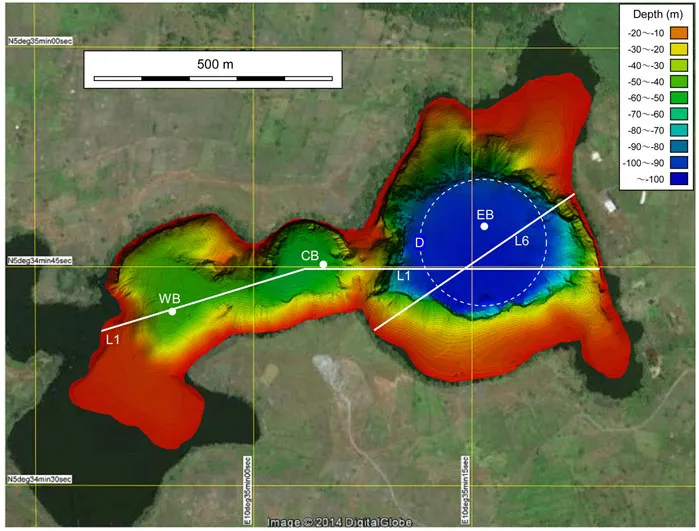 Photo: Lake Monoun, via www.frontiersin.org
Geologists from the U.S. Geological Survey, alongside French and Cameroonian scientists, essentially had to construct the explanatory framework from scratch. They took water samples at various depths, measured gas concentrations, and built the first working model of how a lake could become a pressurized CO2 reservoir. The papers they published didn't just describe what had happened at Lake Nyos — they defined a new category of natural disaster for the first time in the scientific literature.
The Fix Was as Strange as the Problem
Once scientists understood what Lake Nyos was doing, the next question was obvious: could it happen again? The answer was yes, absolutely, and possibly worse — the lake was still heavily saturated with dissolved CO2 at depth.
The solution they eventually implemented is one of the more quietly remarkable pieces of engineering in recent memory. Starting in 2001, teams installed a series of pipes running from the lake's floor to the surface, designed to slowly and continuously bleed off the dissolved gas in controlled amounts — essentially degassing the lake over time before pressure could build to catastrophic levels again.
It works by siphoning. Water from the deep, CO2-saturated layer rises through the pipe under its own pressure and releases gas at the surface as a controlled fountain. It looks almost peaceful — a gentle plume of water and gas rising harmlessly into open air. The same process that killed nearly 1,800 people in a single night is now being managed as a slow, controlled trickle.
The Lake That Changed Everything Scientists Thought They Knew
What makes Lake Nyos genuinely unhinged isn't just the death toll or the strange science — it's the timeline. This happened in 1986, not 1886. It happened during the era of satellite communication, international scientific cooperation, and modern geological monitoring. And the world's scientific community still had to admit, collectively, that they had never considered this specific scenario.
There are other CO2-saturated lakes in the world, most of them also in the African Rift Valley region. Lake Kivu, on the border of the Democratic Republic of Congo and Rwanda, holds roughly 300 times the dissolved gas of Lake Nyos — and two million people live on its shores.
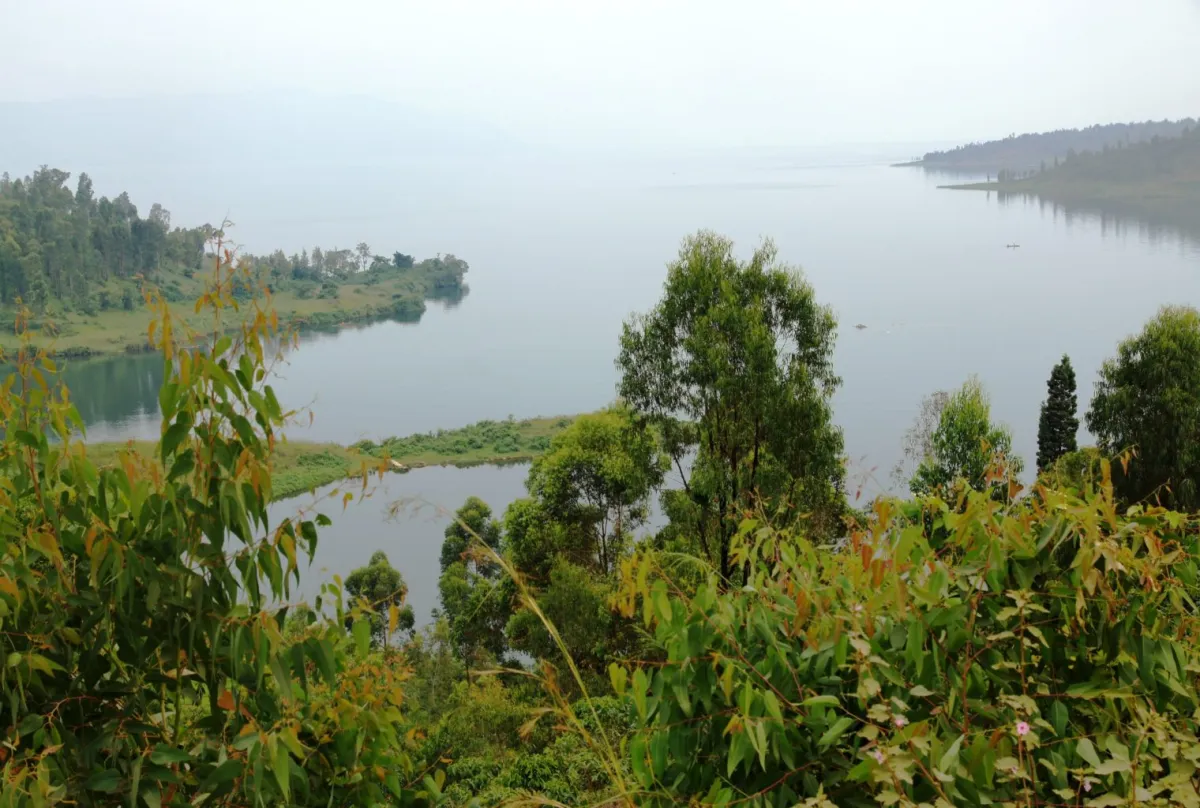 Photo: Lake Kivu, via journeysbydesign.com
The pipes at Lake Nyos are still running. The science is still being refined. And somewhere at the bottom of a beautiful blue crater lake, pressure is still building, slowly, the way it always has.
The only difference now is that someone is watching.