The Ghost Writer of America: How a Forgotten Founder Secretly Authored Our Most Famous Words

The Most Famous Words Nobody Can Attribute
"We the People of the United States, in Order to form a more perfect Union..." These might be the most recognizable words in American history, memorized by countless schoolchildren and carved into marble monuments. But here's something that would have blown the minds of those memorizing students: nobody really knows who wrote them.
Well, that's not entirely true. Historians know—they just spent about two centuries arguing over the wrong guy.
The Convention That Almost Kept No Records
The Constitutional Convention of 1787 was supposed to be a quick fix-up job on the Articles of Confederation. Instead, it turned into a complete governmental overhaul conducted in secrecy so intense that delegates weren't even allowed to discuss proceedings with their wives. The official record-keeping was, to put it mildly, a disaster.
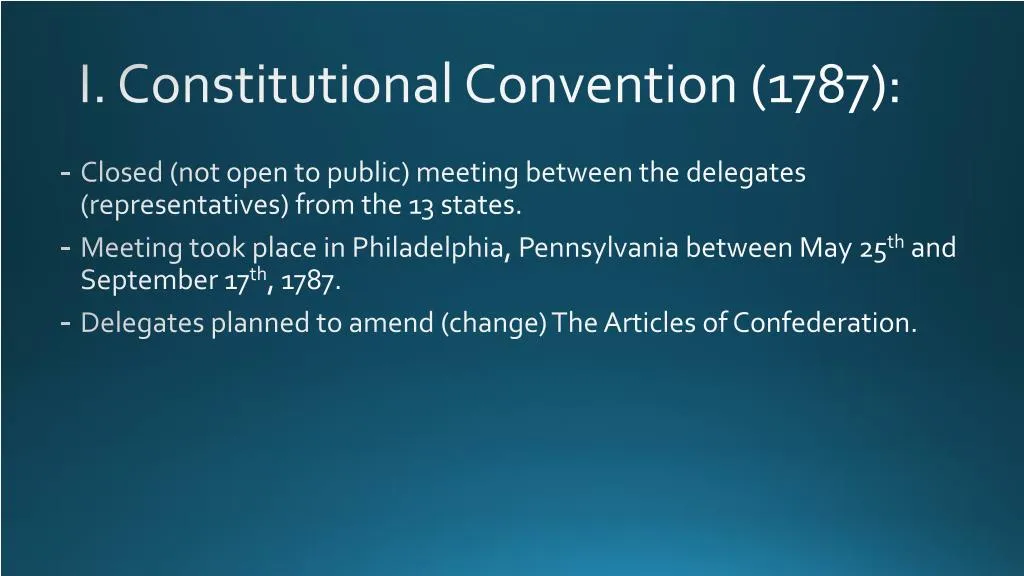 Photo: Constitutional Convention of 1787, via image1.slideserve.com
This information vacuum created a perfect storm for historical confusion. When Americans later wanted to know who deserves credit for founding their country, they had to rely on fading memories, personal letters, and a whole lot of educated guessing.
The Man Behind the Curtain
Enter Gouverneur Morris, a peg-legged Pennsylvania delegate who might be the most important Founding Father you've never heard of. While names like Washington, Jefferson, and Franklin dominated the spotlight, Morris was quietly doing something that would outlast all their speeches: he was rewriting the Constitution.
Not just editing it—completely rewriting it. The Committee of Style handed Morris a rough draft that read like it was assembled by a committee (which it was), and he transformed it into the eloquent document we know today. More importantly, he wrote the Preamble from scratch.
The Printing Error That Confused History
Here's where things get truly unhinged: Morris never told anyone what he'd done. The Convention's records were sparse, and when the Constitution was published, there was no byline crediting specific authors to specific sections. Morris just... let it slide.
Meanwhile, a clerical error in early historical documents led many to believe that another delegate had authored the Preamble. For decades, the wrong person received credit while Morris watched from the sidelines, apparently unbothered by the mix-up.
The Accidental Author Who Never Wrote Anything
The man who got credit was Edmund Randolph of Virginia, who had indeed proposed the Virginia Plan that became the Constitution's foundation. But Randolph's contribution was structural—he provided the framework, not the words. The confusion arose because early historians conflated "proposing the plan" with "writing the final document."
 Photo: Edmund Randolph, via worldhistoryedu.com
Randolph himself never claimed to have written the Preamble, but once the myth took hold, it became historical fact. Textbooks repeated it, monuments referenced it, and Morris continued saying nothing.
The Truth Hiding in Plain Sight
The real story only emerged decades later when historians began digging through Morris's personal papers. His letters revealed not just that he'd written the Preamble, but that he'd crafted it with specific philosophical goals in mind.
Morris had deliberately changed the opening from "We the People of the States of..." (followed by a list of individual states) to simply "We the People of the United States." This wasn't just stylistic—it was a fundamental shift from a confederation of separate states to a unified nation.
The Words That Created a Country
That small change transformed the entire meaning of American government. Instead of thirteen separate entities grudgingly working together, Morris's language created a single people forming a single nation. It was a linguistic coup that redefined what America would become.
Morris later admitted he'd made this change deliberately, knowing it would face opposition if debated openly. By burying it in the final editing process, he managed to sneak one of the most significant philosophical shifts in American history past the entire Constitutional Convention.
The Founding Father Who Founded in Secret
What makes this story even stranger is Morris's personality. He wasn't a shrinking violet—he was known for his wit, his social life, and his willingness to speak his mind. Yet when it came to his most important contribution to American history, he kept quiet for years.
Morris finally acknowledged his authorship in private letters written in the 1810s, more than two decades after the Constitution was ratified. By then, the wrong attribution had become so entrenched that correcting it would have required rewriting textbooks across the country.
The Historical Correction That Came Too Late
Modern historians now credit Morris with writing not just the Preamble but much of the Constitution's final language. He transformed a dry legal document into something approaching poetry, creating phrases that would inspire generations of Americans.
Yet even today, many Americans don't know Morris's name. He remains the ghost writer of American democracy, the man who gave voice to the nation's founding principles while someone else got the speaking credit.
The Lesson Hidden in the Mix-Up
Morris's story reveals something unsettling about how history gets written. The most important contributions often happen behind the scenes, in editing rooms and committee meetings where nobody's keeping careful records. The people who get remembered are often those who spoke the loudest, not those who wrote the words that mattered most.
In Morris's case, his anonymity might have been intentional. By avoiding credit, he also avoided the political controversies that plagued other Founding Fathers. While Hamilton and Jefferson feuded publicly, Morris's ideas became so embedded in American government that they seemed natural rather than political.
The Words That Outlasted Their Author
Today, Gouverneur Morris's words are recited at citizenship ceremonies, printed on government buildings, and taught to every American schoolchild. His vision of "a more perfect Union" became the philosophical foundation for everything from the Civil War to the civil rights movement.
Yet most Americans who can recite "We the People" couldn't pick Morris out of a lineup of Founding Fathers. He achieved something rare in American history: he created something more famous than himself, then stepped back and let it speak for the nation he helped invent.