The Unlikely Spy Who Never Knew She Was Spying
In the paranoid landscape of 1950s America, while the CIA was burning through millions of dollars trying to understand what the Soviets were thinking, a small-town Texas librarian named Margaret Whitfield was accidentally building a better intelligence operation using nothing but index cards, colored pencils, and an unhealthy obsession with proper cataloging.
She had no idea she was out-performing the federal government's best minds. She just really, really liked organizing things.
The Librarian Who Couldn't Say No
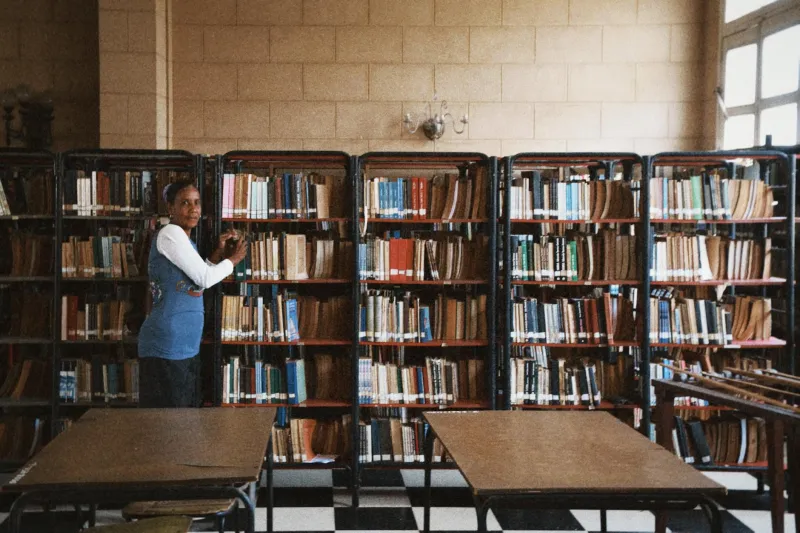
Margaret Whitfield ran the Millerville Public Library (population 3,200) with the kind of militant efficiency that would make a drill sergeant weep with pride. When local residents started asking her to help them access foreign newspapers and scientific journals — partly out of Cold War curiosity, partly because the nearest university library was 200 miles away — Whitfield did what any reasonable librarian would do.
She said yes to everything.
Within months, Whitfield had established subscriptions to 47 foreign newspapers, 23 scientific journals, and 15 technical publications from countries across Europe, Asia, and South America. Her reasoning was beautifully simple: "If people want to read it, we should have it."
What she created next would accidentally revolutionize American intelligence gathering.
The Filing System That Broke Reality
Whitfield couldn't just pile foreign publications in a corner and call it a day. Her librarian DNA wouldn't allow such chaos. Instead, she developed what she called her "Cross-Reference Coordination System" — a filing method so obsessively detailed it bordered on the supernatural.
Every article in every foreign publication was:
- Summarized in English
- Categorized by topic, country of origin, and date
- Cross-referenced with related articles from other publications
- Indexed by author, subject matter, and potential relevance to American interests
- Color-coded by perceived importance (her own judgment)
Within two years, Whitfield had created a searchable database of foreign information that was more comprehensive and accessible than anything the U.S. government possessed.
The Patterns Only She Could See
Whitfield's system revealed something that escaped professional intelligence analysts: patterns. Her cross-referencing methodology allowed her to connect seemingly unrelated pieces of information across multiple countries and time periods.
She noticed when Soviet agricultural publications mentioned the same crop failures that appeared in Romanian trade journals. She spotted connections between Chinese industrial reports and North Korean technical papers. She tracked the movement of scientific personnel across Eastern European countries by following their published research.
Most remarkably, she began creating what she called "summary reports" — monthly overviews of significant trends and developments she'd identified through her reading. These reports, typed on her personal typewriter and filed away in manila folders, contained intelligence insights that would have made CIA analysts jealous.
The Discovery That Changed Everything
In 1957, a traveling businessman named Robert Chen stopped by the Millerville library looking for recent Chinese technical journals. Chen, who was actually a State Department official conducting informal intelligence gathering in small-town libraries (yes, that was a real thing), was expecting to find maybe a dusty magazine or two.
 Photo: Robert Chen, via wealthplanfinancial.com
Instead, he found Whitfield's archive.
Chen later wrote in his classified report: "Subject has independently created the most sophisticated open-source intelligence operation I have encountered outside of Washington. Her analytical capabilities appear to exceed those of trained professionals."
The Quiet Government Invasion
Within weeks of Chen's report, Millerville started receiving unusually well-dressed "researchers" who claimed to be studying rural library systems. These researchers spent hours examining Whitfield's filing methods, asking detailed questions about her cataloging processes, and taking extensive notes.
Whitfield, being a helpful librarian, cheerfully explained her entire system to anyone who asked. She even provided detailed written instructions when the researchers claimed they wanted to implement similar systems in other libraries.
She had no idea she was training federal intelligence officers.
The System That Went National
Declassified documents from the 1990s reveal that the CIA's Foreign Broadcast Information Service quietly adopted Whitfield's cross-referencing methodology in 1958. Her color-coding system became the basis for the agency's information priority rankings. Her summary report format was implemented across multiple intelligence divisions.
The federal government essentially stole a small-town librarian's filing system and used it to reorganize American intelligence gathering.
Whitfield never received credit, compensation, or even acknowledgment. The closest thing to recognition came in a 1963 memo that referred to "the Texas methodology" and noted its "exceptional effectiveness in pattern identification and trend analysis."
The Truth That Stayed Hidden
Margaret Whitfield continued running the Millerville library until her retirement in 1978, never knowing that her obsessive organization had revolutionized American intelligence. She died in 1984, taking her secrets with her — not because she was trying to hide anything, but because she genuinely had no idea her work had been significant.
The truth only emerged in 1994 when a former CIA analyst named David Morrison published a memoir that mentioned "borrowing methodologies from an unnamed Texas librarian whose analytical instincts surpassed those of trained professionals."
Further investigation by intelligence historians revealed the full scope of Whitfield's accidental contributions to American national security.
The Legacy of Accidental Excellence
Today, elements of Whitfield's system are still used in intelligence analysis, though few practitioners know the origin of their methods. Her approach to cross-referencing diverse information sources became foundational to modern open-source intelligence gathering.
The woman who just wanted to help her neighbors read foreign newspapers had accidentally created analytical tools that helped America navigate the Cold War.
Sometimes the most important intelligence work happens in the most unlikely places, performed by people who never intended to be spies at all.