The Suburban Paint War That Forced California to Outlaw a Color
When Purple Became Public Enemy Number One
In 1973, the quiet suburban streets of Mill Valley, California, became ground zero for what might be the most absurd legislative battle in American municipal history. What started as a simple disagreement between two homeowners over exterior paint colors escalated into an actual city ordinance that legally prohibited a specific shade of purple from appearing on any structure within city limits.
Yes, you read that correctly. An entire California town went to war against a color.
The Feud That Launched a Thousand Legal Briefs
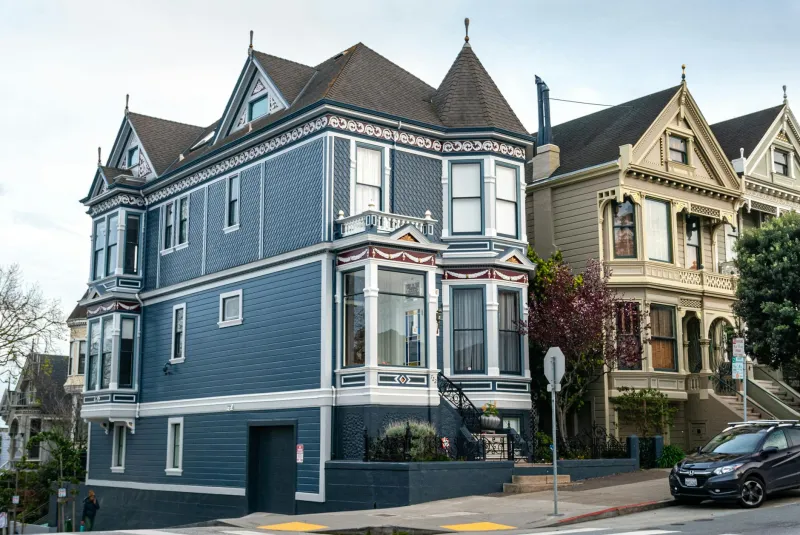
The trouble began when Margaret Thornfield decided to paint her Victorian-era home in what she described as "a lovely lavender hue." Her next-door neighbor, retired attorney Harold Pemberton, had other ideas. Pemberton claimed the color was actually "an offensive purple monstrosity" that violated the neighborhood's "aesthetic integrity."
What made this dispute particularly unhinged was Pemberton's response. Rather than filing a simple complaint with the homeowners association, he spent three months researching municipal law and discovered that Mill Valley's zoning ordinances contained vague language about "maintaining community standards" and "preserving neighborhood character."
Pemberton argued that Thornfield's paint job constituted a public nuisance under these provisions. But here's where things get truly bizarre: instead of challenging the color in general terms, Pemberton's legal filing specified the exact paint manufacturer, product line, and color code – Benjamin Moore's "Amethyst Shadow #2071-30."
The City Council's Nuclear Option
Faced with mounting legal pressure and what local newspapers dubbed "The Great Purple Crisis," Mill Valley's city council took the most extreme action possible. Rather than mediate between two feuding neighbors, they passed Emergency Ordinance 73-15, which specifically prohibited "the exterior application of Benjamin Moore Amethyst Shadow #2071-30 or any substantially similar hue" on residential or commercial structures.
The ordinance included a color chart attachment and required city inspectors to carry paint sample cards to identify violations. Properties found in violation faced daily fines of $50 (roughly $300 in today's money) until the offending color was removed.
City Councilwoman Dorothy Chen later admitted the decision was "completely insane," but explained that the alternative was months of expensive litigation that the small municipality couldn't afford.
The Legal Precedent Nobody Saw Coming
What happened next surprised everyone involved. Instead of quietly repainting her house, Thornfield hired a civil rights attorney and challenged the ordinance as an unconstitutional restriction on property rights and free expression.
The case, Thornfield v. City of Mill Valley, worked its way through California's court system for two years. While Thornfield ultimately lost on appeal, the legal arguments established several important precedents that property law experts still reference today.
Most significantly, the California Court of Appeals ruled that municipalities could indeed regulate specific colors and design elements, provided they followed proper procedures and could demonstrate a "compelling community interest." This decision gave homeowners associations and city governments unprecedented power to micromanage aesthetic choices.
The Unintended Consequences
By 1978, more than 200 California municipalities had adopted similar color restrictions, though none quite as specific as Mill Valley's purple ban. The trend spread nationwide, with HOAs from Florida to Washington implementing increasingly detailed design codes that regulated everything from roof materials to mailbox styles.
Legal scholars now point to the Mill Valley purple ordinance as the beginning of modern "aesthetic zoning" – the practice of using municipal law to enforce subjective design standards. What started as one neighbor's complaint about a paint job fundamentally changed how American communities regulate property appearance.
The Color That Wouldn't Die
The story gets even stranger. Benjamin Moore, apparently amused by the controversy, began marketing Amethyst Shadow #2071-30 as "the color California tried to ban." Sales of the paint increased by 400% in the months following the court decision.
Mill Valley kept the ordinance on the books until 1987, when a new city council finally repealed it during a broader revision of municipal codes. By then, however, the damage was done – the legal framework for regulating property aesthetics had spread across the country.
A Legacy Written in Purple
Today, Margaret Thornfield's former home sits at 412 Elm Street in Mill Valley, painted a sensible beige that offends absolutely nobody. Harold Pemberton passed away in 1994, but his legal victory lives on in thousands of HOA covenants that restrict everything from fence heights to flower garden designs.
The Mill Valley purple ban stands as perhaps the perfect example of how American local government can spiral into complete absurdity when faced with determined neighbors and creative lawyers. It's a reminder that in a country built on individual liberty, sometimes the most trivial disputes can reshape the legal landscape in ways nobody anticipates.
And yes, Benjamin Moore still makes Amethyst Shadow #2071-30. It remains one of their most popular purple shades, probably because nothing sells paint quite like being banned by an entire city.