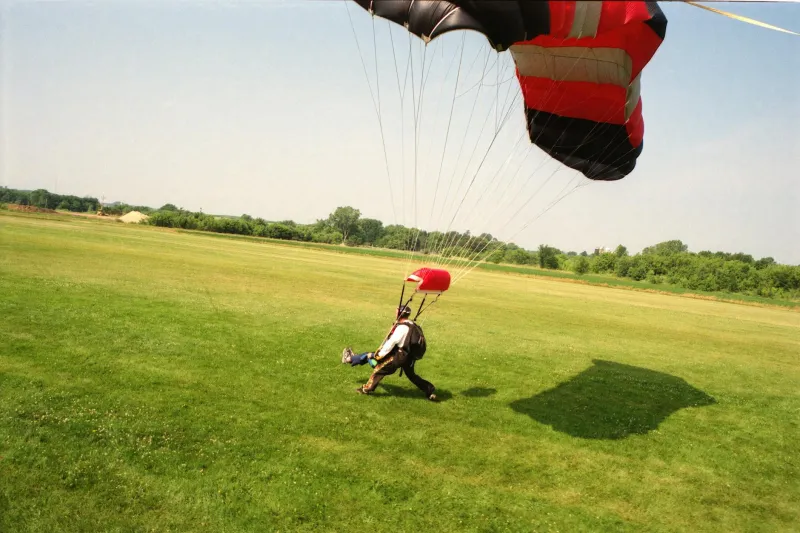
The Jump That Defied Every Law of Physics
On a crisp October morning in 2007, 21-year-old Shayna Richardson stepped out of a plane at 10,000 feet above Siloam Springs, Arkansas, expecting a routine skydive. Instead, she was about to become the subject of medical case studies that would puzzle trauma surgeons for decades.
 Photo: Siloam Springs, Arkansas, via cdn-assets.alltrails.com
When Richardson pulled her ripcord, nothing happened. Her main parachute tangled into a useless mess of fabric. Her backup chute deployed partially, then twisted around the first one, creating what skydivers call a "ball of death" — essentially a cloth anchor that does nothing to slow your descent.
Richardson was now in freefall at terminal velocity: 120 miles per hour, heading straight for a parking lot.
The Landing That Should Have Been a Funeral
What happened next violates every principle of human survival. Richardson slammed face-first into the asphalt parking lot of a restaurant, creating a small crater in the pavement. Witnesses expected to find a body. Instead, they found a woman who was not only alive but conscious and talking.
The impact should have been instantly fatal. At terminal velocity, hitting concrete is equivalent to being struck by a freight train. The human body simply isn't designed to absorb that kind of force and continue functioning.
But Richardson wasn't just surviving — she was asking bystanders to call her boyfriend.
The Medical Mystery That Rewrote Textbooks
At the hospital, doctors discovered something that made Richardson's survival even more impossible: she was pregnant. Not only had she survived a fall that should have killed her instantly, but so had her unborn child.
Dr. Michael Langer, the trauma surgeon who treated Richardson, later told reporters that her case "defied every known model of survivable impact." She had suffered a broken pelvis, punctured lung, and facial fractures — injuries that were serious but nowhere near fatal given what she'd just experienced.
 Photo: Dr. Michael Langer, via terasaki.org
The baby showed no signs of distress. No complications. No trauma.
Medical experts began studying Richardson's case to understand how two lives could survive an impact that physics said should have ended them both. The consensus? There was no scientific explanation.
The Pregnancy Plot Twist
Here's where the story gets even stranger: Richardson didn't know she was pregnant when she jumped. She'd been skydiving regularly and had no idea she was carrying a child during her death-defying hobby.
The pregnancy likely saved her life. The additional weight and shifted center of gravity may have changed her falling position just enough to distribute the impact differently. But even accounting for that variable, her survival remained statistically impossible.
Doctors estimate that surviving a fall from that height has odds somewhere around one in several million. Surviving while pregnant? The math doesn't even exist.
The Aftermath That Confused Everyone
Richardson recovered fully and gave birth to a healthy daughter nine months later. The baby showed no developmental issues or complications from her unconventional introduction to extreme sports.
The case became required reading in trauma surgery programs across the country. Medical students study Richardson's X-rays and impact reports as an example of how human survival can occasionally transcend everything science understands about physics and biology.
Several documentaries have featured her story, but Richardson herself remains remarkably matter-of-fact about the experience. In interviews, she describes the fall as "just something that happened" — a perspective that somehow makes the whole thing even more surreal.
The Science That Gave Up
Researchers have proposed dozens of theories about Richardson's survival. Maybe she hit at precisely the right angle. Maybe the parking lot surface had just enough give. Maybe the partial parachute slowed her descent by a few crucial miles per hour.
But every theory falls apart under scrutiny. The impact was simply too severe, the forces too extreme, the odds too astronomical.
Dr. Langer eventually stopped trying to explain it scientifically. "Sometimes," he said, "medicine encounters cases that exist beyond our understanding. Shayna Richardson is one of those cases."
Reality's Greatest Plot Armor
Richardson's story reads like the kind of miracle survival tale that screenwriters would be embarrassed to pitch. A pregnant skydiver survives terminal velocity impact, gives birth to a healthy baby, and walks away with injuries less severe than most car accidents?
Hollywood executives would send that script back with notes about "unrealistic plot armor" and "suspension of disbelief issues."
Yet it happened. In broad daylight. With witnesses. With medical records. With a healthy daughter who exists today as living proof that sometimes reality writes stories so absurd that fiction wouldn't dare attempt them.
The next time someone tells you that truth is stranger than fiction, just remember: somewhere in Arkansas, there's a woman who survived falling from the sky at 120 miles per hour while pregnant, and both she and her daughter are doing just fine, thank you very much.