Six Seasons, One Eye, and Zero Suspicion: The NFL's Most Remarkable Medical Blind Spot
The Play That Started the Questions
It was a routine post-game physical. The kind of appointment that gets treated like a formality after years of the same results coming back clean. Except this time, the examining physician rotated the eye chart, asked the player to cover his right eye, and got an answer that made him stop writing mid-note.
The left eye — the one that had supposedly been cleared every single season for six years — couldn't read the second line.
What followed wasn't just a medical correction. It was the unraveling of one of the most quietly extraordinary stories in professional football history: a backup quarterback who had spent the better part of a decade competing at the highest level of the sport while legally blind in one eye, and who had done it well enough that nobody — not team doctors, not opposing scouts, not league officials — had ever thought to look twice.
How the Screening Was Supposed to Work
The NFL's pre-season physical protocol is not casual. Players are poked, prodded, imaged, and evaluated across dozens of metrics before they're cleared to practice. Vision testing is part of that checklist — specifically for skill position players like quarterbacks, whose ability to read coverage and track receivers downfield is considered functionally inseparable from their job description.
The standard used is basic visual acuity: can you see clearly at distance, with and without correction? A player with corrected vision can still play. A player who is legally blind in one eye — defined as best-corrected visual acuity of 20/200 or worse — falls into a different category entirely, one that triggers additional review under the league's player safety guidelines.
The quarterback in question had a condition called amblyopia, commonly known as lazy eye, in his left eye. It had likely been present since childhood. It had almost certainly been present at every single pre-draft evaluation and every team physical he'd ever sat through.
And for six seasons, it had simply not been caught.
The Mechanics of a Missed Diagnosis
How does something like this slip through? The answer is mundane in a way that feels almost insulting given the stakes.
Vision screenings in professional sports are typically conducted with the dominant eye tested first. For a right-handed quarterback, that's the right eye. If the dominant eye passes cleanly — and his did, every time — the non-dominant eye is often tested more quickly, sometimes with the player still slightly squinting from the previous test, sometimes with inadequate lighting, sometimes simply with less attention paid to the numbers on the chart.
Amblyopia in a non-dominant eye, particularly in an adult who has spent a lifetime compensating for the imbalance, can be subtle. The brain learns to suppress the weaker eye's input and rely almost entirely on the stronger one. The person rarely notices. They don't bump into things. They don't struggle to read. They just have an invisible gap in their visual field that they've been unconsciously routing around for as long as they can remember.
For a quarterback, that compensation has real consequences on the field — it affects depth perception, peripheral tracking, and the ability to locate receivers in the far corner of the end zone. But if you've never known anything different, you develop workarounds. You turn your head slightly more. You anticipate routes rather than purely tracking them. You get good at reading the pre-snap picture before the play even develops.
In other words, you become a smart quarterback. And smart quarterbacks tend to stick around.
Six Seasons Is a Long Time to Keep a Secret You Don't Know You're Keeping
The remarkable part of this story isn't the deception — there wasn't any. The player didn't hide his condition. He didn't bribe team physicians or fake his way through eye charts. He genuinely didn't know. His vision had always been exactly what it was, and since nobody had ever flagged it, he had no reason to believe it was unusual.
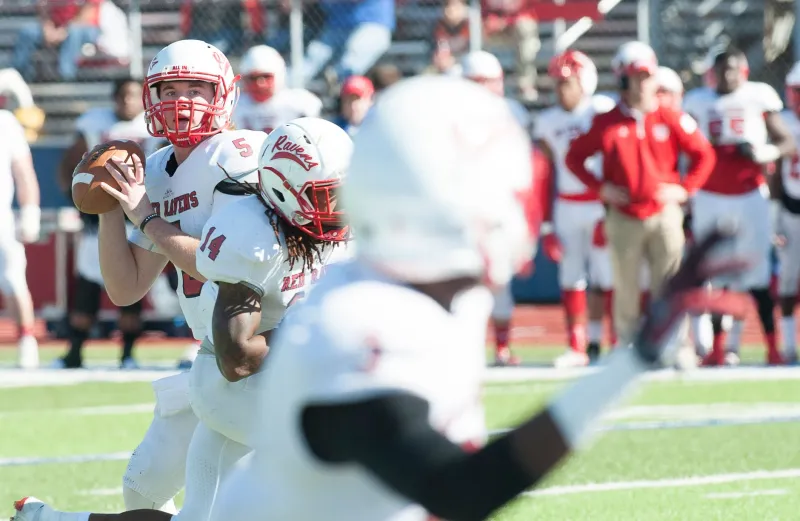
He had thrown a game-winning touchdown pass in a divisional playoff game. He had logged enough regular-season snaps to accumulate a respectable stat line. He had done everything a solid backup quarterback is supposed to do: be ready, be capable, and occasionally be brilliant when called upon.
All of it with a visual system that, on paper, should have kept him out of the league entirely.
When the condition was finally identified, the league's response was notably quiet. There were no press releases, no formal announcements, no public acknowledgment that a player had spent half a decade competing under conditions that the league's own safety protocols were designed to prevent. The player was referred to a specialist, fitted with a corrective contact lens, and cleared to continue playing — now with documented accommodations on file.
What It Says About the System
The NFL spends enormous resources on player safety. Concussion protocols, cardiac screening, orthopedic evaluations — the machinery around player health is vast, expensive, and genuinely sophisticated in many areas.
But this story is a reminder that sophisticated systems have blind spots. Pun intended, unfortunately.
The vision screening that missed six years of amblyopia wasn't incompetent. It was just fast, routine, and designed to catch the obvious. The obvious, in this case, wasn't where the problem was hiding.
The quarterback eventually retired with a career that most backup quarterbacks would envy — a playoff appearance, a game-winning drive that still gets replayed in highlight packages, and the distinction of being arguably the most visually impaired passer to ever take a regular-season snap in professional football.
He's said in interviews since that learning about his eye was strange, but not particularly distressing. He'd been doing fine, after all.
The league, for its part, quietly updated its vision testing protocols the following offseason.
They didn't announce that either.