When Science Meets Desperation (and Explosives)
The summer of 1890 had been brutal across Texas. Crops withered, cattle died, and entire communities faced economic ruin as drought stretched into its third consecutive year. Faced with agricultural catastrophe, the federal government did what any reasonable authority would do: they decided to solve the problem by bombing the atmosphere into submission.
What followed was one of the most ambitious — and explosively bizarre — scientific experiments in American history. The U.S. Weather Bureau's "Concussion Theory of Rainfall" program deployed military-grade artillery across the Texas plains in a systematic attempt to shock moisture out of reluctant clouds.
The strangest part? It actually seemed to work sometimes, which created a whole new set of problems.
The Science Behind the Explosions
The concussion theory wasn't entirely crazy, which made it dangerous. The idea, developed by meteorologist Robert Dyrenforth, suggested that the shock waves from large explosions could trigger condensation in moisture-laden air, essentially jump-starting the rainfall process.
Dyrenforth's reasoning was based on legitimate observations: thunder often preceded heavy rainfall, and European reports suggested that major battles sometimes triggered unexpected weather changes. If natural atmospheric disturbances could produce rain, why couldn't artificial ones?
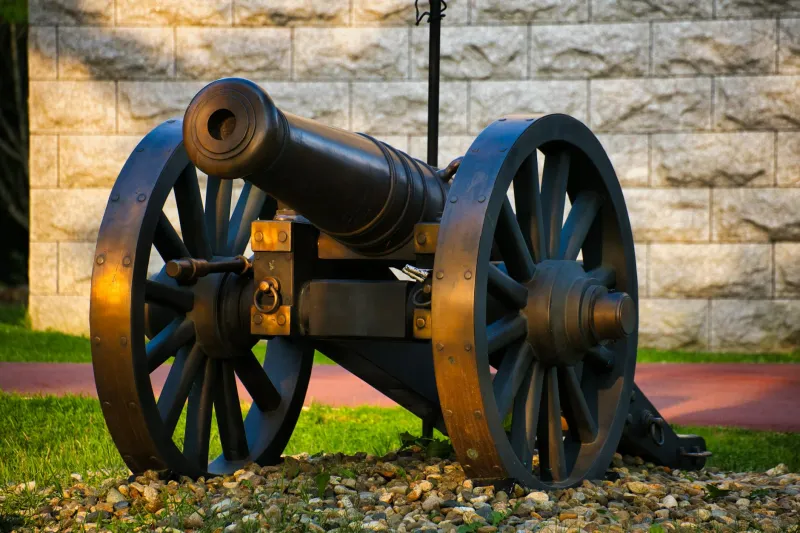
Congress, desperate for any solution to the drought crisis, appropriated $9,000 for experimental testing. It was enough money to purchase serious firepower: military cannons, industrial-grade dynamite, and specially designed "rain mortars" that could launch explosive charges hundreds of feet into the air.
Operation: Make It Rain
The experiments began in August 1891 near Midland, Texas. Dyrenforth's team established what was essentially a weather warfare base camp, complete with artillery positions, ammunition storage, and meteorological equipment to measure results.
The protocol was surprisingly sophisticated. Teams would monitor atmospheric conditions, identify promising cloud formations, then systematically bombard the sky with timed explosions. They used everything from traditional cannons firing blank charges to custom-built mortars that could deliver explosive packages directly into cloud formations.
On August 17, 1891, the first full-scale test began at 3 PM with clear skies and moderate humidity. Over the next four hours, Dyrenforth's team launched 144 explosive charges into the atmosphere, creating what one observer described as "the sound of continuous thunder from a cloudless sky."
At 7:23 PM, it started raining.
Success, Failure, or Cosmic Coincidence?
The timing seemed too perfect to be coincidental, but the results were frustratingly inconsistent. Some bombardment sessions produced immediate rainfall; others resulted in nothing but noise and smoke. The program's first week included three apparent successes and four complete failures, creating a success rate that was either encouraging or meaningless, depending on your perspective.
Local newspapers seized on every successful experiment while largely ignoring the failures. "SCIENCE CONQUERS DROUGHT" proclaimed the Dallas Morning News after a particularly impressive demonstration that produced a two-hour thunderstorm. "GOVERNMENT RAIN MACHINE SAVES TEXAS CROPS" announced the Houston Chronicle.
But meteorologists outside the program remained skeptical. The timing of successful rain-making attempts often coincided with natural weather patterns that suggested rain was likely anyway. Critics argued that Dyrenforth was simply taking credit for storms that would have occurred without intervention.
The Problem with Partial Success
The ambiguous results created a political and scientific nightmare. Complete failure would have ended the program immediately, but the occasional dramatic success kept funding alive and expectations high. Farmers began demanding rain-making services for their specific regions. Politicians promised expanded programs. Other drought-stricken states requested their own artillery-based weather modification.
Meanwhile, the scientific community was split between those who saw legitimate potential in concussion theory and those who viewed the entire enterprise as expensive superstition with cannons.
The controversy intensified when a September 1891 experiment near San Antonio produced not just rain, but a violent thunderstorm with golf-ball-sized hail that destroyed more crops than the drought had. Suddenly, the program faced lawsuits from farmers claiming that government explosions had created destructive weather.
When Rain-Making Becomes Rain-Breaking
By October 1891, the experimental program had produced twelve apparent successes, eighteen clear failures, and six results so ambiguous that both sides claimed victory. More problematically, several "successful" rain-making sessions had produced severe storms that caused significant property damage.
The final experiment, conducted near El Paso on November 3, 1891, resulted in the program's most dramatic success and ultimate downfall. The bombardment session triggered a massive thunderstorm that dropped over three inches of rain in two hours — and spawned a tornado that destroyed a railroad depot and killed two people.
The tornado created a legal and ethical crisis that no amount of agricultural benefit could justify. Families of the victims sued the federal government for wrongful death, arguing that the rain-making experiment had directly caused the destructive weather.
The End of Atmospheric Artillery
Congress quietly discontinued funding for the concussion rain-making program in early 1892, citing "inconclusive results and safety concerns." The official report noted that while some experiments had produced "encouraging outcomes," the program could not definitively prove causation between explosions and rainfall.
Dyrenforth continued advocating for his theory until his death in 1910, but never received government support for additional testing. The cannons were returned to military service, the mortars were scrapped, and the entire episode was largely forgotten except by meteorologists and legal scholars studying government liability for weather modification.
The Legacy of Federal Sky-Bombing
The 1891 rain-making experiments represent a fascinating intersection of legitimate science, desperate politics, and spectacular technological overreach. The concussion theory wasn't entirely wrong — modern cloud seeding techniques use different methods but similar principles to trigger precipitation.
What made the program truly unhinged wasn't the science, but the scale and the weaponry. The idea that the federal government could solve drought by systematically bombing the atmosphere captures something essentially American about the relationship between technology, nature, and optimistic aggression.
Today, Texas still struggles with periodic drought, but solutions focus on water conservation and distribution rather than atmospheric bombardment. The 1891 experiments remain a reminder that sometimes the most scientific approach to a problem can also be the most spectacularly misguided.
Somewhere in the National Archives, there's probably still a file labeled "Weather Modification Through Concussive Force" containing detailed records of the year the U.S. government tried to end drought by declaring war on the sky itself.