The Engineer Who Cheated Nuclear Death Twice in Three Days
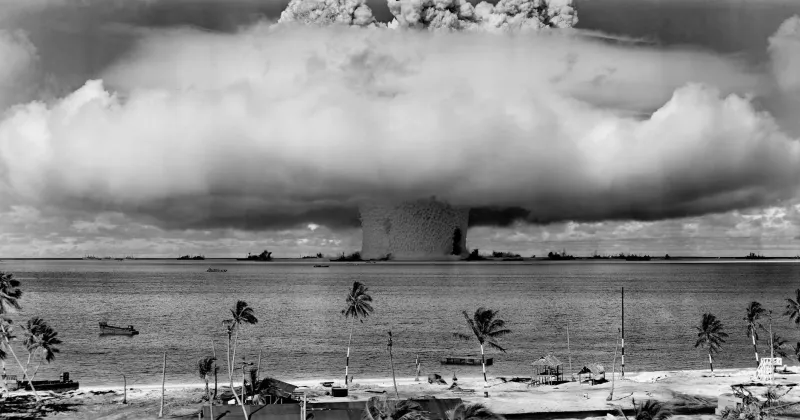
Picture this: You're on a business trip when a nuclear weapon explodes overhead. You survive, somehow. You make it home, bandaged and traumatized, only to have another atomic bomb detonate in your hometown three days later. And you survive that one too.
This sounds like the plot of the world's most depressing superhero movie, but it actually happened to one man: Tsutomu Yamaguchi, a Japanese naval engineer whose life reads like a cosmic joke with a 70-year punchline.
The Worst Business Trip Ever
On August 6, 1945, 29-year-old Yamaguchi was wrapping up a three-month work assignment in Hiroshima for Mitsubishi Heavy Industries. He was walking to catch a streetcar when the world exploded around him.
At 8:15 AM, the Enola Gay dropped "Little Boy" about 1.8 miles from where Yamaguchi stood. The flash temporarily blinded him, the heat wave burned his face and arms, and the blast threw him into a ditch. When he crawled out, Hiroshima had become a moonscape.
Most people in his situation would have been vaporized instantly. The fact that he survived with "only" severe burns and ruptured eardrums was already a statistical miracle. But Yamaguchi's story was just getting started.
Going Home to Round Two
Despite his injuries, Yamaguchi was determined to get back to his family in Nagasaki. He spent the night in a shelter, then caught one of the few trains still running. The journey that normally took a few hours stretched into an agonizing overnight trip through a devastated landscape.
He arrived home on August 8, heavily bandaged and barely recognizable. His wife initially thought he was a stranger. After convincing her it was really him, Yamaguchi tried to rest and recover from what should have been a once-in-a-lifetime brush with nuclear annihilation.
Then August 9 arrived.
Lightning Strikes Twice, Atomically
Yamaguchi had dragged himself to work at the Mitsubishi shipyard in Nagasaki, where he was telling his supervisor about the Hiroshima bombing. His boss was skeptical — surely one bomb couldn't destroy an entire city.
At 11:02 AM, "Fat Man" detonated about 1.8 miles away. Again.
This time, Yamaguchi knew exactly what was happening. He dove under a desk as the familiar white flash filled the sky, followed by the heat, then the blast wave that shattered windows and collapsed buildings. When the chaos subsided, he emerged once again from nuclear devastation.
The mathematical odds of surviving one atomic bombing are already astronomical. Surviving two, in different cities, within 72 hours? Statisticians probably don't even have numbers for that level of improbability.
The Long Road to Recognition
Yamaguchi lived a remarkably normal life after his nuclear double-feature. He returned to work, raised three children, and lived to age 93 — dying in 2010 of stomach cancer, likely related to his radiation exposure.
But here's where the story gets even stranger: Japan didn't officially recognize him as a survivor of both bombings until 2009, when he was 93 years old. For decades, bureaucratic red tape prevented him from being acknowledged as what he obviously was — the only person confirmed to have survived both atomic attacks.
The Japanese government had separate recognition systems for Hiroshima and Nagasaki survivors, and apparently nobody thought to create a checkbox for "survived both." It took until Yamaguchi was literally on his deathbed for officials to figure out how to handle his unprecedented case.
The Unsinkable Human
Yamaguchi spent his later years speaking about his experiences, advocating for nuclear disarmament with the unique authority of someone who had been atomically bombed twice and lived to tell about it.
"I can't understand why the world cannot understand the agony of the nuclear bombs," he said in interviews. "How can they keep developing these weapons?"
His story challenges everything we think we know about survival, probability, and the randomness of catastrophe. In a different timeline, Yamaguchi might have been vaporized in Hiroshima on August 6. In another, he might have stayed home to recover and missed Nagasaki entirely.
Instead, he became living proof that reality occasionally writes stories too strange for fiction — a man whose life defied nuclear physics, statistical probability, and common sense, all while maintaining the most Japanese response possible: going back to work the next day.
Sometimes the universe has a sense of humor. It's just not always funny.